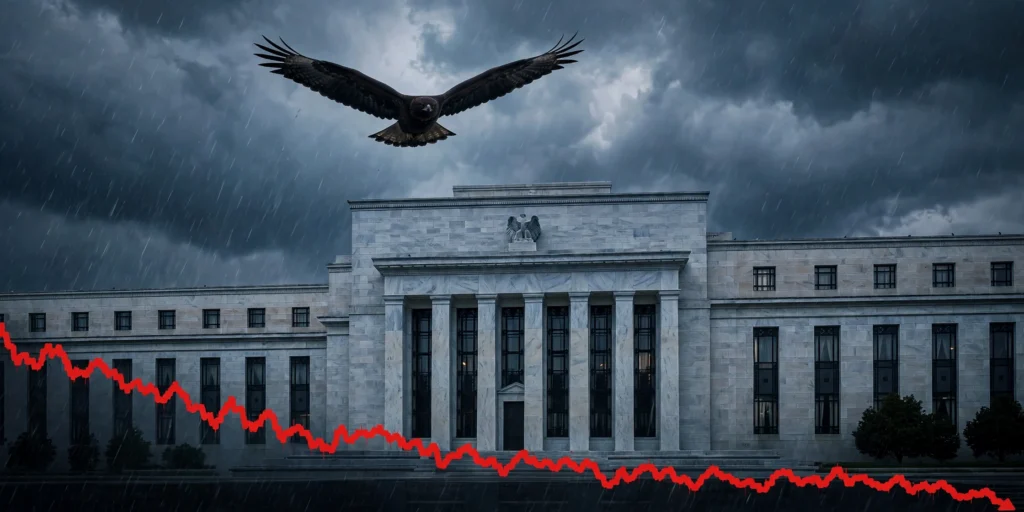
Trump’s Warsh Fed Chair Nomination: What It Means for Crypto in 2026
Warsh Fed Chair Nomination Rattles Crypto as Derisking Takes Hold
President Donald Trump’s decision to nominate Kevin Warsh as the next chair of the Federal Reserve has sent a wave of caution through cryptocurrency markets. Within days of the announcement, traders moved to derisk, Bitcoin slid, and an October selloff that had already battered digital assets deepened. The reaction tells a story bigger than one nomination: crypto has become a creature of macroeconomic policy, rising and falling on the outlook for interest rates as much as on anything happening inside the industry.
Trump made the nomination public on Friday on Truth Social: “I am pleased to announce that I am nominating Kevin Warsh to be the chairman of the board of governors of the Federal Reserve.” The pick capped months of speculation: betting markets had given Warsh odds near 92.5 percent, far ahead of alternatives.
The market response was swift. Bitcoin, already under pressure, dropped toward $69,798 after briefly touching $70,434 on Saturday. That followed a brutal week in which the largest cryptocurrency sank to nearly $60,000. October has delivered the largest liquidation event in the asset class’s history, with more than $19 billion in crypto bets wiped out earlier in the month, plus billions more in leveraged positions liquidated last week. US spot Bitcoin ETFs saw weekly net outflows of $360 million, while Ethereum ETFs lost $161 million, according to Farside Investors data.
The reason for the selling was straightforward: Warsh has spent his career as an inflation hawk, and markets do not expect him to rush toward lower rates. “Investors wanted to derisk over Trump’s Federal Reserve chair nomination,” DL News reported, noting that Warsh “has typically been an inflation hawk in the past and could therefore be in no rush to cut interest rates.” Standard Chartered warned Bitcoin could fall to $50,000 before stabilizing, while analytics firm CryptoQuant put a realistic bottom at $55,000.
Who Is Kevin Warsh? The Inflation Hawk Behind the Name
To understand why the Warsh Fed chair nomination rattled markets, it helps to know the man. Warsh is no stranger to the central bank: he served as a member of the Federal Reserve Board of Governors from 2006 to 2011, making him one of the youngest governors in the institution’s history. He sat on the Board through the 2008 financial crisis, and his record from that era built his reputation as a hawk — someone who favors strict monetary discipline, tighter liquidity, and higher interest rates, and who has consistently warned about an overexpanded central bank balance sheet.
Since leaving the Fed, Warsh has been a lecturer at the Stanford Graduate School of Business, a senior fellow at the Hoover Institution, and a former Morgan Stanley banker. Last year he publicly said he wanted to lower the cost of borrowing while criticizing quantitative easing and balance-sheet expansion — positions that initially seemed aligned with Trump’s demands for lower rates.
That alignment is more complicated than it looks. Trump has spent months pressuring the current chair, Jerome Powell, over the pace of rate cuts, even floating rates near 1 percent. But Warsh’s hawkish instincts mean he may not follow the aggressive easing path the president wants: a president demanding deep cuts, and a nominee whose entire record says inflation control comes first.
Warsh was also a finalist for the chairmanship in Trump’s first term before Powell got the job. His return to the top of the shortlist — and now the formal nomination — shows how the Fed personnel fight has become one of the most market-moving political stories of 2026.
Why Fed-Chair Politics Now Moves Bitcoin Prices
A decade ago, the idea that a Federal Reserve nomination would move Bitcoin would have seemed strange. It no longer is. The Warsh nomination proves Bitcoin now trades like a macro asset — sensitive to interest rates, Treasury yields, and central bank credibility.
The mechanics are simple. High interest rates make borrowing more expensive, which puts a damper on high-risk assets such as cryptocurrency. Low-rate environments, by contrast, have historically been kind to Bitcoin: cheap money pushes investors toward higher-return assets, and Bitcoin has repeatedly performed well when financial conditions were loose. As one DL News analysis put it, “Bitcoin and major digital coins and tokens have typically performed well in a low-interest rate environment.”
What the market is pricing now is the opposite. Data from the CME Group’s FedWatch tool shows investors pricing in virtually no chance of rate cuts this year — a “higher-for-longer” stance that tightens liquidity and lifts real rates. The two-year US Treasury yield has jumped to 4.14 percent, its highest since early 2025, and sits above the Fed’s current target range. That matters because the two-year yield has been a reliable guide for three decades: the Fed has tended to raise rates when the two-year climbs above the federal funds rate, and to cut when it falls below.
CME data even suggests the December Fed meeting could deliver a 25 basis point rate hike rather than a cut — a painful repricing for a crypto market that spent much of 2025 betting on easier policy.
The Inflation Hawk Paradox: Crypto-Friendly but Rate-Hostile
Here is the paradox at the heart of the Warsh Fed chair nomination. On monetary policy, Warsh is an inflation hawk whose tenure could mean tighter conditions for risk assets. On crypto itself, he may be the most Bitcoin-friendly person ever nominated to lead the central bank.
In an interview hosted by the Hoover Institution, Warsh said: “Bitcoin does not make me nervous…Bitcoin doesn’t trouble me, I think of it as an important asset that can help inform policymakers when they are doing things right and wrong.” That contrasts sharply with Jerome Powell, who has consistently played down Bitcoin’s relevance to the US economy.
Warsh’s interest goes back years. In a 2018 Wall Street Journal op-ed, he wrote that Bitcoin’s price volatility “significantly diminishes its usefulness as a reliable unit of account or an effective means of payment,” but added that “Bitcoin might, however, serve as a sustainable store of value, like gold.” In 2022, he floated a new digital dollar to compete with China’s central bank digital currency, while cautioning that China’s digital yuan was “at odds with the American ethos of privacy from government intrusion.”
The crypto industry has noticed. Michael Saylor, co-founder of Bitcoin treasury company Strategy, posted on X: “Soon, Kevin Warsh will be the first pro-Bitcoin chairman of the Federal Reserve.” The result is a nominee who is crypto-friendly on regulation yet potentially hawkish on rates — good for the industry’s legitimacy, bad for asset prices in the near term.
Scenarios for a Warsh-Led Fed and Crypto Markets
What happens next depends on several moving parts, and investors should think in scenarios rather than certainties.
The first scenario is the hawk’s path: Warsh takes the chair after Senate confirmation, prioritizes inflation control, and keeps rates elevated — or even hikes in December, as CME pricing suggests is possible. The dollar stays strong, real yields stay high, and Bitcoin remains under pressure. The nomination-week derisking turns out to have been the rational response.
The second scenario is the pragmatist’s path. Warsh has argued that productivity growth — particularly from artificial intelligence — could justify a more accommodative stance. One analyst quoted this week predicted that “Warsh will cut,” using “the AI productivity and trimmed inflation excuses” to justify easing. In this world, a Warsh Fed surprises markets by moving toward cuts once inflation data cooperates, crypto benefits from the liquidity tailwind, and the early derisking proves overdone.
The third scenario is political friction. Trump has made no secret of wanting a Fed chair who listens to the White House. Warsh’s independence could produce public clashes with the president. The nomination still needs Senate confirmation, and hearings will give Warsh his first chance to signal where he really stands.
The most likely outcome is probably a blend: a hawkish-leaning chair who eases only when the data forces his hand. For crypto, the macro overlay dominating 2026 trading is unlikely to lift soon.
What Crypto Investors Should Watch Next
Several signposts matter more than day-to-day price moves. First, the Senate confirmation hearings, which will reveal whether Warsh intends to be the hawk his record suggests or the pragmatist some analysts expect. Second, the December Fed meeting, where CME data now points to a possible 25 basis point hike — a shock after a year of cut expectations. Third, the Treasury yield curve: if the two-year yield keeps climbing above the funds rate, history says tighter policy is coming. And fourth, whether a pro-Bitcoin chair translates into friendlier Fed policy toward banks holding digital assets.
The Warsh Fed chair nomination marks a turning point for crypto’s relationship with Washington. The industry has won the legitimacy battle. But legitimacy does not pay for liquidity. Until the rate picture clears, Bitcoin stays the most macro-sensitive asset in the market, held hostage by the bond market’s verdict on the next chair.
FAQ
Has Kevin Warsh been confirmed as Fed chair? Not yet. Trump announced the nomination on Friday; it still requires Senate confirmation. Jerome Powell’s term as chair ends in May 2026.
Is Warsh good or bad for crypto? Both. He has spoken positively about Bitcoin — good for legitimacy and the regulatory outlook. But his record as an inflation hawk suggests he will not rush to cut rates — bad for prices in the near term.
Why did markets fall on the nomination news? Investors derisked because a hawkish Fed chair implies higher-for-longer rates. With CME data pricing in virtually no rate cuts this year, traders sold risk assets including Bitcoin.
What is the “higher-for-longer” scenario? The market’s base case: the Fed keeps rates elevated through 2026 to contain inflation, real yields stay high, and liquidity stays tight — an environment that historically pressures Bitcoin.
What should crypto investors watch next? Senate confirmation hearings, Warsh’s early policy signals, the December Fed decision, Treasury yield trends, and whether a pro-Bitcoin chair brings friendlier Fed policy toward banks and digital assets.
Source: DL News
Related reading on MM Crypto Analysis Web
- Community Bank Stablecoin Push: OCC Urges Small Lenders to Issue Tokens
- Coinbase Data Breach Amplitude: Vendor Leak and Bithumb Fallout
- Crypto.com and OG.com Launch CFTC-Regulated 24/7 Perpetuals for US Traders
More in Regulation on MM Crypto Analysis Web.
