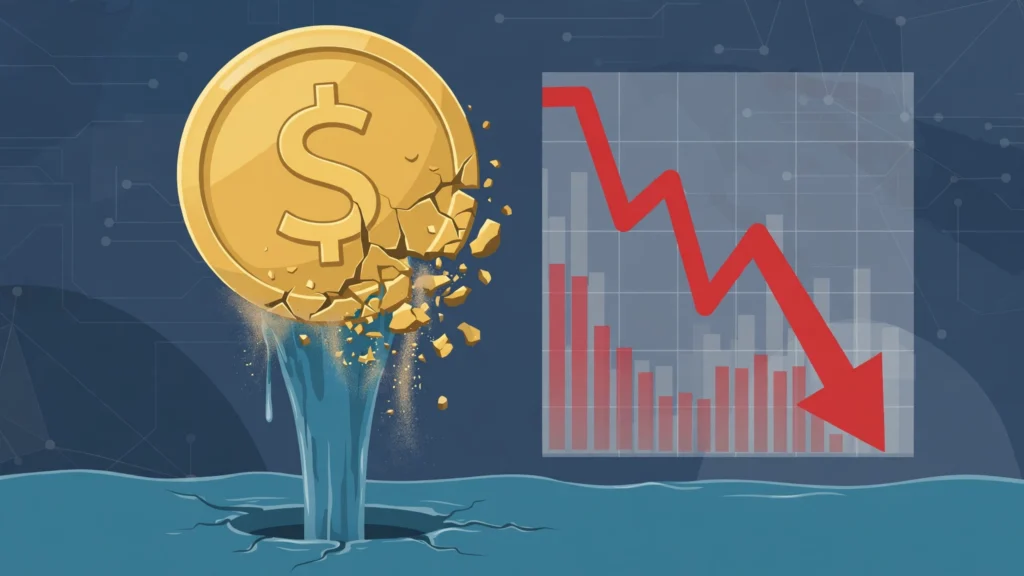
Tether’s USDT Sheds $1B in Market Cap Over Five Days
Tether’s USDT shed nearly $1 billion in market capitalization over five days in mid-October, a contraction in stablecoin supply that is raising questions about whether Bitcoin’s recovery can hold without fresh liquidity entering the market.
The move matters less as a single headline number than as a signal about conditions inside the market. Market capitalization for a stablecoin of this kind reflects the amount in circulation, so a fall of this size over such a short period points to a meaningful reduction in the supply available to traders at that moment. It does not by itself explain why the reduction happened, and it does not by itself settle where prices will go next, but it gives traders and observers a concrete reason to ask whether the buying power that supported the recent recovery is still growing, holding steady, or beginning to drain away.
Why Stablecoin Supply Matters
Stablecoins are the settlement currency of crypto trading. When their supply contracts — through redemptions or capital rotation — it often signals that dry powder is leaving the ecosystem. Traders watch USDT and USDC supply as a proxy for the liquidity available to absorb selling or fuel rallies.
In practical terms, settlement currency is the asset traders actually use to complete trades, move between positions, and park capital while they decide what to do next. A trader who sells one crypto asset often receives a stablecoin in return, and a trader who wants to buy often starts from a stablecoin balance. Because of that role, the total supply of widely used stablecoins functions as a rough gauge of how much immediately usable capital is sitting inside the trading system, ready to be deployed without first bringing in funds from outside.
The idea of dry powder captures that readiness. Dry powder is capital that is held back, available, and able to move quickly when an opportunity or a need arises. When stablecoin supply expands, it can suggest that more of that ready capital is entering or being prepared inside the market. When supply contracts, it can suggest the opposite: that some of that capital has been redeemed, moved elsewhere, or rotated into a different kind of holding. None of those possibilities is visible from the supply figure alone, which is why observers treat a contraction as a prompt for further questions rather than as a complete explanation on its own.
Traders watch USDT and USDC supply for the same reason. A single stablecoin can move for reasons specific to that token, to its issuer, or to the venues where it is most heavily used. Watching more than one widely used stablecoin helps observers judge whether a move looks broad, affecting the overall pool of trading capital, or narrow, affecting only one corner of it. Even then, supply is only one lens among several. It sits alongside trading volumes, order-book depth, flows into and out of other investment products, and the broader mood of risk appetite, and it is most useful when read together with those other signals rather than in isolation.
A Wobbling Recovery
The USDT contraction arrived alongside a choppy tape: Bitcoin has struggled to hold above $83,000, Ether ETF outflows have topped $1 billion for October, and options traders are paying up for downside protection. A shrinking stablecoin float adds one more headwind to a market already short on momentum.
Bitcoin has been grinding in the low-$80,000s, and analysts have been debating whether spot ETF inflows alone can carry the next leg higher without a broader expansion of on-chain liquidity.
Grinding is a useful description of that kind of price action. It suggests movement without clean direction: advances that fail to extend, declines that fail to deepen decisively, and a market that spends time moving sideways while participants reassess. In that setting, a level such as $83,000 takes on importance not because of anything inherent in the number itself, but because repeated difficulty in holding above it tells traders that buying interest at higher prices has so far been insufficient to sustain a break higher. Each failed attempt can leave the market a little more cautious, as traders who bought near the top of the range wait to see whether the next attempt fares better.
The debate about spot ETF inflows reflects a similar tension. Flows into exchange-traded products that track a crypto asset represent one channel through which new demand can reach the market. When those flows are strong, they can support prices even if other channels are quiet. When they are not enough on their own, the question becomes whether other forms of liquidity — including on-chain stablecoin balances and broader trading capital — are expanding enough to make up the difference. On-chain liquidity, in this context, simply means capital that is already present within blockchain-based trading and settlement systems, available to be used without waiting for a transfer from outside. A contraction in stablecoin supply therefore feeds directly into that debate, because it points to one part of on-chain liquidity moving in the wrong direction for a sustained advance, at least for the period covered.
Ether ETF outflows topping $1 billion for October add a second strand to the same picture. Outflows from such products indicate that, on balance for that period, more capital was leaving those products than entering them. That does not describe every holder or every day within the month, and it does not by itself determine the price of Ether or Bitcoin. What it does suggest is that one regulated, accessible channel for exposure was experiencing net withdrawal pressure during the same period in which stablecoin supply was contracting and Bitcoin was struggling to hold higher ground. When several channels point in the same cautious direction at once, traders tend to read the combination as a broader cooling of appetite, even if each individual signal is open to more than one interpretation.
Taken together, these elements describe a market short on momentum. Momentum, in market language, is the tendency for a move to keep going once it has started, carried by fresh buying or selling that reinforces the direction. A market short on momentum is one in which advances fade, declines are met with cautious rather than enthusiastic buying, and participants wait for a clearer catalyst. A shrinking stablecoin float does not create that condition on its own, but it adds one more headwind — one more factor leaning against a swift resumption of upward movement — at a time when other headwinds are already visible.
What Redemptions And Capital Rotation Can Mean
Tether has not commented on the drivers of the redemptions. Stablecoin supply moves in both directions, and past contractions have reversed quickly when risk appetite returns.
The absence of comment matters because it leaves the cause open. A redemption, in general terms, is the process by which a holder exchanges a stablecoin back for the underlying value it represents, thereby removing that token from circulation. Capital rotation is a different but related idea: capital moving from one asset, venue, or strategy to another, rather than leaving the broader financial system altogether. Both can reduce the measured supply of a particular stablecoin, but they imply different things about where the capital has gone and whether it might return. Without a statement from the issuer about which drivers were at work, observers cannot distinguish cleanly between those possibilities from the supply figure alone.
The observation that past contractions have reversed quickly when risk appetite returns is important context for the same reason. Risk appetite is a general term for willingness to hold volatile or uncertain assets rather than seeking safety or liquidity. When appetite returns, capital that had been withdrawn or parked elsewhere can flow back into trading, and stablecoin supply can expand again as holders re-enter positions or prepare to trade. That history does not guarantee that any particular contraction will reverse, or that it will reverse on any particular timetable. It does, however, caution against treating a five-day move as permanent. Supply is a flow measure that responds to changing conditions, and its direction can change as those conditions change.
Why Liquidity Still Decides The Next Phase
The central question raised by this contraction is whether Bitcoin’s recovery can hold without fresh liquidity entering the market. That question will not be answered by the stablecoin figure alone, but the figure sharpens it. If fresh liquidity arrives — through renewed risk appetite, through inflows into spot products, or through a renewed expansion of on-chain balances — then a period of grinding price action can give way to a more sustained move. If it does not arrive, then the market may continue to grind, with advances meeting selling and declines finding only cautious support, until conditions change.
That picture is, for now, one of caution. A nearly $1 billion contraction over five days in mid-October, set against Bitcoin grinding in the low-$80,000s, Ether ETF outflows topping $1 billion for October, and traders paying up for downside protection, describes a market in which liquidity and momentum are both under pressure. It does not describe a market that has already resolved its direction. It describes a market at a point of testing, where the return of risk appetite and fresh liquidity would change the tone, and where their continued absence would leave the recovery still to prove itself.
Frequently Asked Questions
How much did USDT market capitalization fall, and over what period?
Tether’s USDT shed nearly $1 billion in market capitalization over five days in mid-October.
Why do traders watch stablecoin supply?
Stablecoins are the settlement currency of crypto trading, and traders watch USDT and USDC supply as a proxy for the liquidity available to absorb selling or fuel rallies.
What other market signals arrived alongside the USDT contraction?
Bitcoin struggled to hold above $83,000, Ether ETF outflows topped $1 billion for October, and options traders were paying up for downside protection.
Has Tether commented on the drivers of the redemptions?
Tether has not commented on the drivers of the redemptions.
Do stablecoin contractions always continue?
No. Stablecoin supply moves in both directions, and past contractions have reversed quickly when risk appetite returns.
Source: Crypto Briefing
Related reading on MM Crypto Analysis Web
- RLUSD Moody’s Rating: A2 Grade Makes Stablecoin History
- The GENIUS Act 87-Day Squeeze: Filing Window Still Shut for Stablecoin Issuers
- Solana Stablecoin Holders Hit 14 Million as Network Adoption Expands
More in Stablecoins on MM Crypto Analysis Web.
