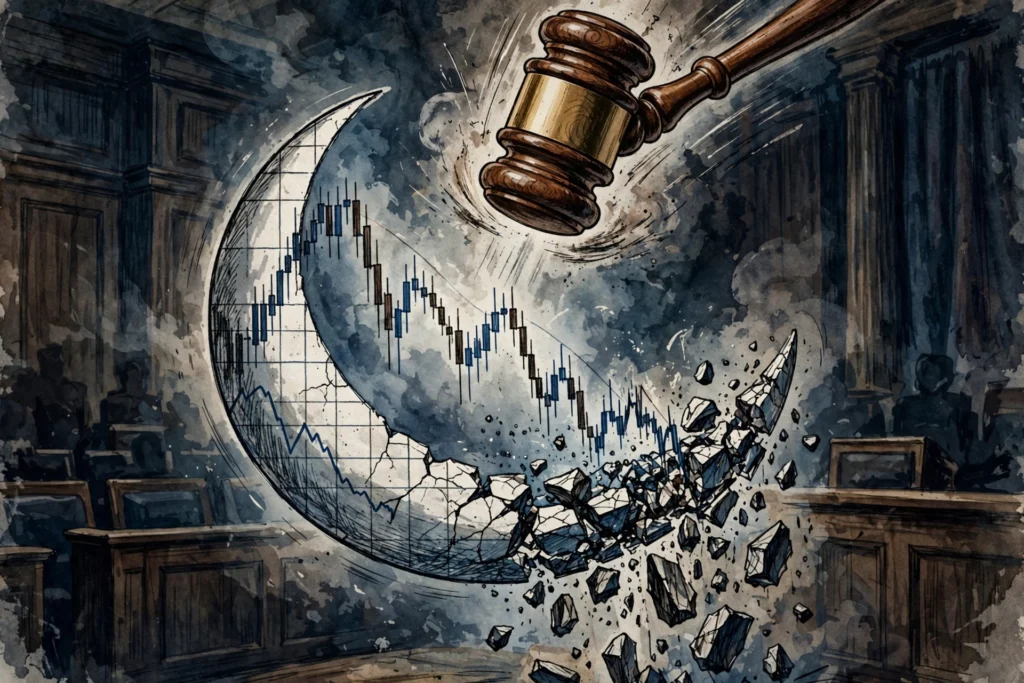
Jane Street Sued Over Alleged Terra-Luna Insider Trading
Trading giant Jane Street has been sued over allegations that it used insider information to profit during the 2022 Terra-Luna collapse — a case that is dragging one of crypto’s most painful chapters back into the spotlight.
The Allegations
The lawsuit claims Jane Street traded with non-public information during the UST crisis in May 2022, positioning itself to profit while the Terra ecosystem unraveled from a $40 billion valuation to zero. The claims remain unproven, and the allegations have not been adjudicated.
The Terra collapse was the defining disaster of the last bear market, triggering a chain of insolvencies — Three Arrows Capital, Voyager, Celsius — that wiped out an estimated $2 trillion in crypto market value. Any new legal action touching it tends to reopen old wounds.
A Market That Moved On
Coincidentally or not, the market moved higher as the news circulated. Traders had spent weeks complaining about a recurring pattern of Bitcoin selling pressure around 10 a.m. market hours, and some online speculation connected the lawsuit’s timing to the pattern’s sudden absence. There is no confirmed evidence linking the two — markets move for many reasons, including short covering and oversold technical conditions.
What the episode does show is how thin the line is between narrative and price action in crypto. A lawsuit about a 2022 event became, within hours, a live market thesis.
Why It Matters
Jane Street is one of the world’s most sophisticated trading firms and a major liquidity provider across crypto markets. If the allegations were ever substantiated, the implications for market structure — who knew what, and when, during crypto’s biggest meltdown — would be enormous.
For now, the case joins a long list of Terra-related litigation grinding through the courts. Traders will keep watching both the docket and the tape.
Remembering the UST Crisis 2022
To understand the Terra Luna collapse lawsuit, readers first need the event at its centre: the UST crisis 2022. Terra was built around two linked tokens. UST was designed as a dollar-pegged stablecoin, while Luna was the volatile token meant to absorb shocks and keep UST near one dollar through an arbitrage mechanism. In May 2022, confidence cracked, UST lost its peg, and the mechanism designed to save it instead accelerated the collapse as vast amounts of new Luna were created. The ecosystem that had been valued at $40 billion unraveled to effectively zero.
The human cost explains why the story still resonates. Retail savers who treated UST as a low-risk dollar product lost money they believed was safe. Funds and lenders exposed to Terra, directly or through counterparties, faced sudden holes in their balance sheets. The chain of insolvencies that followed — Three Arrows Capital, Voyager, and Celsius among them — turned one project’s failure into a market-wide crisis, contributing to an estimated $2 trillion fall in crypto market value during that bear market. Any Terra Luna collapse lawsuit therefore lands on ground that is still emotionally and financially sensitive for many participants.
What Insider Trading Means in This Context
The Jane Street insider trading allegations at the heart of this case concern a simple and serious idea: trading while in possession of material information that the rest of the market does not have. In traditional markets, insider trading law is well developed, with rules about who owes a duty of confidence and what counts as material non-public information. In crypto markets in 2022, the legal map was far less clear, especially for tokens traded globally, around the clock, on venues with very different disclosure standards.
- Material means information a reasonable investor would consider important to a decision.
- Non-public means the information was not generally available to the market at the time of the trade.
- Allegation is not proof: a lawsuit states a claim; a court must still test the evidence.
That last point matters most when reading headlines. The claims in this Terra Luna collapse lawsuit remain unproven and have not been adjudicated. Jane Street, like any defendant, is entitled to contest the facts, the law, and the interpretation of its trading. Crypto history is full of confident early narratives that looked very different once documents, timestamps, and full trading records were examined in court.
Why Jane Street’s Role Draws Scrutiny
Jane Street is not a small crypto-native shop. It is described in the original report as one of the world’s most sophisticated trading firms and a major liquidity provider across crypto markets. Large liquidity providers sit close to the flow of orders. They see demand forming, they quote prices across venues, and they manage risk in milliseconds. That legitimate market-making role is essential — without it, spreads widen and ordinary investors pay more — but it also means their activity during a crisis attracts intense retrospective attention.
If the Jane Street insider trading allegations were ever substantiated, the implications would extend beyond one firm. Questions would follow about information sharing during the UST crisis 2022, about how trading firms interacted with struggling projects, and about whether some participants were able to protect themselves with knowledge unavailable to the public who were still holding UST and Luna. If the allegations are not substantiated, the case will instead become another example of how difficult it is to reconstruct intent from trading patterns during a chaotic market collapse. Either outcome will teach the market something, which is why legal specialists as well as traders are paying attention.
Narrative, Price Action, and the 10 A.M. Pattern
The original story notes a curious market subplot: as news of the lawsuit circulated, the market moved higher, and some online speculation linked that move to the sudden absence of a recurring pattern of Bitcoin selling pressure around 10 a.m. market hours that traders had complained about for weeks. The report is careful, and readers should be too: there is no confirmed evidence linking the two. Markets rise for many ordinary reasons, including short covering after a selloff and oversold technical conditions that invite bargain hunting.
This episode is a compact lesson in crypto market psychology. A Terra Luna collapse lawsuit is, on its face, a story about events in 2022. Within hours, it had become a live trading thesis about today’s price action. That speed is part of crypto’s appeal and part of its danger. Narratives can organise scattered observations into a story that feels true before any evidence supports it. Responsible traders separate three things that social media often blends together: what is alleged, what is proven, and what merely happened at the same time.
Terra Litigation: A Long Tail
This case joins a long list of Terra-related litigation grinding through courts in several jurisdictions. Large financial collapses rarely produce a single lawsuit. They produce an ecosystem of claims: investors against projects, creditors against lenders, liquidators against counterparties, and regulators against individuals. Each case moves at its own pace, with discovery, motions, and possible settlements stretching over years. For readers, the practical lesson is to expect a slow drip of headlines rather than a single dramatic verdict, and to read each filing for what it actually is — one side’s argument at one stage of a process.
There is a broader significance, too. The rules that will govern the next crisis are being written in cases about the last one. Court decisions on disclosure, market manipulation, and the duties of sophisticated traders will shape how firms behave when the next major token fails. In that sense, the Terra Luna collapse lawsuit matters even to investors who never held UST or Luna and have no view on the parties involved.
What Happens Next in a Case Like This
For readers unfamiliar with civil litigation, it helps to know the road a case like this usually travels. After a complaint is filed, the defendant typically responds, often with a motion to dismiss that argues the claim fails even if its factual assertions are taken at face value. If the case survives that stage, discovery follows: documents are exchanged, witnesses are questioned under oath, and trading records are examined in detail by experts on both sides. Only after that long, largely private process does a case approach trial — and many cases settle before reaching one, without any admission of wrongdoing.
Each stage can generate headlines, and each headline needs careful reading. A court allowing a case to proceed is not a finding that the allegations are true; it is a finding that they deserve to be tested. A settlement, likewise, is not automatically an admission; it is often a commercial decision to end cost and distraction. Keeping those distinctions clear protects readers from the most common error in legal reporting — treating every procedural step as a verdict. The Terra story has already suffered years of confident misreading; this lawsuit deserves more patience than the market usually gives it.
Frequently Asked Questions
What is the Terra Luna collapse lawsuit about?
It alleges that Jane Street used insider information to profit during the May 2022 Terra-Luna collapse. The claims remain unproven and have not been adjudicated, so they should be read as allegations, not findings.
What happened in the UST crisis 2022?
UST, Terra’s dollar-pegged stablecoin, lost its peg in May 2022. The mechanism linking UST and Luna failed under pressure, the ecosystem fell from a $40 billion valuation to zero, and contagion spread to firms including Three Arrows Capital, Voyager, and Celsius.
Why do the Jane Street insider trading allegations matter?
Jane Street is a major liquidity provider. If such allegations were substantiated, they would raise large questions about market structure and fairness during crypto’s biggest meltdown. If not, the case still shows how hard crisis trading is to judge after the fact.
Did the lawsuit cause Bitcoin to rise?
There is no confirmed evidence for that link. The original report notes online speculation about a 10 a.m. selling pattern, but also points to ordinary explanations such as short covering and oversold conditions.
Source: Coinpedia via BitRss
Related reading on MM Crypto Analysis Web
- Crypto Market Close October 28: Breadth Turns Positive as Bitcoin Holds $81,254
- Crypto Market Wrap October 29: Bitcoin Holds Above $81,000 After Fed Hold
- Whales Turn Bearish on Bitcoin for First Time Since June as ETF Flows Stabilize
More in Markets on MM Crypto Analysis Web.
