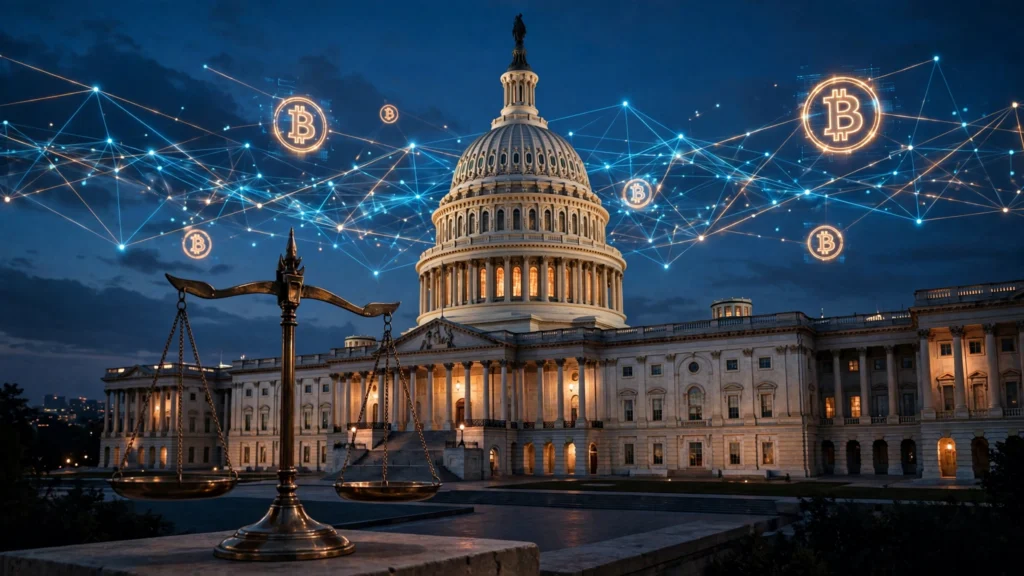
Crypto PACs Spent $170 Million in the Midterms — and the CLARITY Act May Stall for Two Years
Crypto political action committees spent $170 million during the 2026 midterm election cycle, with mixed results, and the industry’s flagship market structure bill, the CLARITY Act, is now seen as stalled for two years after Democrats won control of both chambers of Congress. That assessment comes from Teana Baker-Taylor, chief executive of BasedAI and Kōhai, who discussed the election outcome on episode 51 of The Block’s The Starting Block podcast, broadcast live on November 5, 2026, and hosted by Gareth Jenkinson. Baker-Taylor, a veteran of crypto policy who previously served as vice president of policy and regulatory strategy at Circle and held leadership roles at Binance, Crypto.com, and the Chamber of Digital Commerce, argued that the industry’s problems in Washington are as much about conduct as about politics — and that the path back runs through integrity, not just spending.
The $170 million figure is striking on its own. Crypto PACs have become one of the largest sources of campaign spending in American politics, and the 2026 cycle was their biggest test yet. The results, however, were mixed. The episode’s key topics note that the spending produced mixed results, including Brown’s win in Ohio — a race where crypto-backed spending appears to have helped, even as the broader outcome, a Democratic sweep of both chambers, went against the industry’s preferred result. Democrats take office on January 3, and with them comes a new congressional landscape in which the CLARITY Act, the bill that would define how crypto assets are regulated in the United States, faces a two-year delay.
Crypto PACs Midterms: $170 Million With Mixed Results
The scale of crypto PAC spending in the 2026 cycle reflects how seriously the industry now takes electoral politics. At $170 million, crypto PACs rank among the most active spenders in American elections, deploying resources across primaries and general elections to support candidates seen as favourable to the industry and oppose those seen as hostile. That level of spending was intended to build a crypto-friendly Congress regardless of which party won. The outcome — Democrats winning both chambers — shows the limits of that strategy. Money can influence individual races, and the episode notes Brown’s Ohio win as one where it appears to have mattered, but it cannot determine the overall balance of power when the political tide runs the other way.
Mixed results is the right description. A PAC strategy that wins some races and loses the chamber is a partial success at best, and the industry now faces two years of a Congress controlled by a party whose relationship with crypto is more complicated than the industry’s public messaging often acknowledges. Moderate Democrats have supported crypto legislation in the past, and some continue to do so, but the party as a whole has been sceptical of an industry associated with speculative excess, consumer harm, and political figures whose conduct has drawn scrutiny. The $170 million bought access and influence in individual contests; it did not buy a friendly Congress.
CLARITY Act Stalled: Two Years on Hold
The most consequential policy outcome of the midterms, for the crypto industry, is the fate of the CLARITY Act. The bill, which would establish a comprehensive framework for regulating digital asset markets in the United States, has been the industry’s top legislative priority for years. With Democrats taking both chambers and the bill seen as stalled for two years, that priority is now on hold until at least the next Congress. For an industry that has waited years for regulatory clarity, two more years is a long time — and the delay has real costs, in the form of continued legal uncertainty, constrained institutional participation, and the risk that other jurisdictions set the rules first.
The stall is not simply a matter of partisan arithmetic. Baker-Taylor argued that the fine points holding up the CLARITY Act were ethics-related rather than technical, and that framing changes how the delay should be understood. If the obstacles were technical — disagreements about how to classify tokens, or how to divide jurisdiction between regulators — they could be resolved through negotiation and drafting. Ethics-related obstacles are harder: they concern whether legislators trust the industry and its most prominent figures, and whether they are willing to be seen as enabling an industry whose conduct they find troubling. That kind of obstacle does not yield to better drafting. It yields, if at all, to changed behaviour over time.
The Integrity Check: Melania Coin and World Liberty Financial
Baker-Taylor’s most pointed remarks concerned the industry’s own conduct. She argued that the crypto industry needed an integrity check, pointing to Melania Coin and World Liberty Financial as examples of conduct that alienated moderate Democrats and stalled legislation. The reference to Melania Coin — a token associated with the First Lady — and to World Liberty Financial, a crypto project linked to the Trump family, is significant because both projects sit at the intersection of crypto and political power. For moderate Democrats who might otherwise support crypto legislation, the sight of politically connected tokens launching and trading while the industry seeks favourable regulation creates an obvious conflict of interest problem.
The point is not about the legal status of either project, but about the political signal they send. When legislators are asked to vote for a bill that would benefit an industry, they look at who benefits and how. If the most visible beneficiaries appear to be politically connected insiders, the bill becomes harder to support — not because of its substance, but because of its optics. Baker-Taylor’s argument is that the industry’s political troubles are, at least in part, self-inflicted: by tolerating or celebrating conduct that looks like self-dealing, the industry made it harder for its friends in Congress to help it.
AI Regulation Will Mirror Crypto’s Journey
The conversation on The Starting Block ranged beyond crypto, and Baker-Taylor drew a direct parallel between the regulation of artificial intelligence and the regulation of crypto. She argued that calls to pause AI development are as futile as calls to ban Bitcoin — a comparison that captures the difficulty of stopping a decentralised, globally distributed technology through regulation alone. Just as Bitcoin survived years of scepticism, bans, and enforcement actions to become a major asset class, AI development is unlikely to be halted by regulatory fiat. If a pause is futile, then the realistic goal is not to stop AI development but to shape it — to set standards, require transparency, and create accountability without pretending that the technology can be switched off.
Baker-Taylor argued that open-source AI is in a more defensible regulatory position than frontier labs, because its models are transparent, ring-fenced, and auditable. That argument connects directly to her own work: BasedAI is an open-source AI company building private, sovereign AI tools for businesses, and Kōhai, its first product, is a private open-source multiplayer AI workspace for small businesses. Kōhai is built entirely on open-source, open-weight models and integrates with tools such as Gmail, Figma, Canva, and GitHub through roughly a thousand connectors; BasedAI APIs are on the roadmap within a couple of months. Baker-Taylor said she hopes open source stays off regulators’ radar for now, while encouraging builders to engage with policymakers rather than ignore them.
What Two Years of Delay Means for Crypto
The immediate consequence of the midterm results is a two-year delay for the CLARITY Act, and with it, a two-year extension of the regulatory uncertainty that has defined crypto in the United States. That uncertainty has costs: companies face legal risk, institutions hesitate to commit capital, and the United States risks falling behind jurisdictions that have already established clear frameworks, such as the European Union with MiCA. The DIA study published the same week showed the euro stablecoin market growing 54 percent under MiCA’s licensing regime — a reminder that regulatory clarity, when it arrives, can accompany growth rather than hinder it. If Baker-Taylor is right that the obstacles to the CLARITY Act are ethics-related rather than technical, then the two-year window is an opportunity to address them — to demonstrate the integrity that would make the bill passable when the next Congress convenes.
FAQ
How much did crypto PACs spend in the 2026 midterms?
Crypto political action committees spent $170 million during the 2026 midterm cycle, with mixed results, including Brown’s win in Ohio, according to The Block’s The Starting Block podcast on November 5, 2026.
What happened to the CLARITY Act after the midterms?
The CLARITY Act, the bill that would define how crypto assets are regulated in the United States, is seen as stalled for two years after Democrats won control of both chambers of Congress, taking office on January 3.
Why did Teana Baker-Taylor say the industry needs an integrity check?
Baker-Taylor argued that conduct such as Melania Coin and World Liberty Financial alienated moderate Democrats and stalled legislation, and that the fine points holding up the CLARITY Act were ethics-related rather than technical.
Who is Teana Baker-Taylor?
She is the CEO of BasedAI and Kōhai, an open-source AI company, and previously co-founded Venice AI and served as vice president of policy and regulatory strategy at Circle, with earlier leadership roles at Binance, Crypto.com, and the Chamber of Digital Commerce.
What is Kōhai and what did Baker-Taylor say about AI regulation?
Kōhai is a private, open-source multiplayer AI workspace for small businesses, built on open-source, open-weight models. Baker-Taylor argued that calls to pause AI are as futile as calls to ban Bitcoin, and that open-source AI is more defensible because its models are transparent, ring-fenced, and auditable.
Source: The Block
Related reading on MM Crypto Analysis Web
- ICE Bets on Retail Perpetuals as Wall Street Brings Crypto Trading Onshore
- Democrats Plan a New Crypto Market Structure Bill for the Next Congress
- Crypto Braces for Tougher Rules After Democrats Sweep the Midterms
More in Regulation on MM Crypto Analysis Web.
