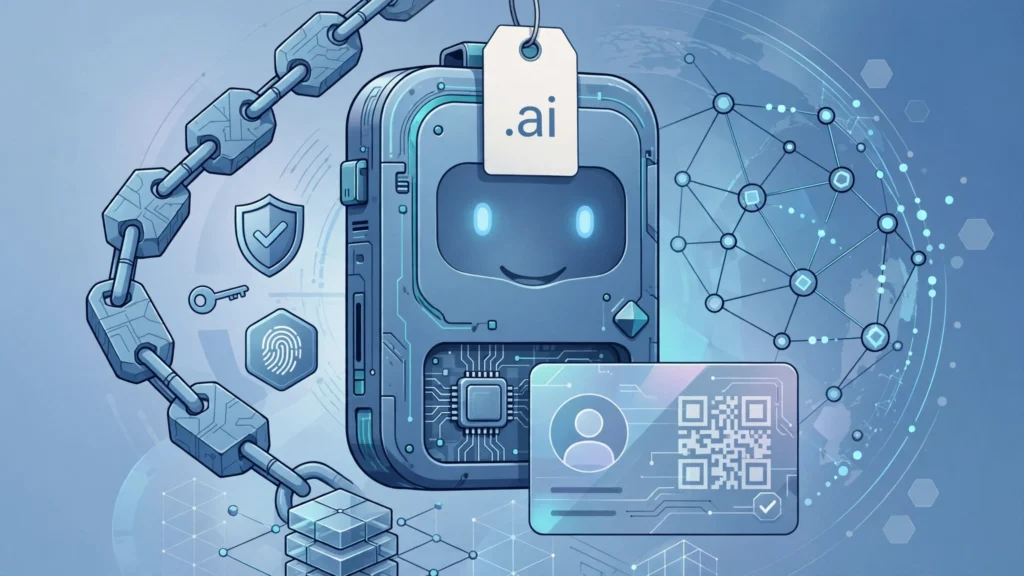
Binance Co-Founder Yi He Launches Agent ID for AI Agent Wallets
Binance co-founder Yi He has introduced Agent ID, a feature that lets users claim personalized names ending in .ai for their artificial intelligence agent wallets within the Binance App. The announcement came on Tuesday. At first glance, the idea sounds simple: give a machine a name instead of a string of characters. In practice, it touches one of the most persistent problems in crypto, which is that the addresses people and programs use to move value were never designed to be read, remembered, or checked by a human eye.
Human Names for Machine Wallets
The initiative replaces lengthy, error-prone “0x” hexadecimal addresses with human-readable identifiers such as “heyi.ai.” Anyone who has ever copied a wallet address knows why that matters. A long string of letters and numbers looks almost identical from one address to another, and a single wrong character can send funds somewhere they were never meant to go. A readable name, by contrast, can be recognized at a glance, spoken aloud, written down, and checked against an expectation before any value moves.
That difference becomes more important as the number of wallets grows. A person might manage a handful of addresses and learn to be careful with each one. A system in which many agents each hold their own wallet quickly produces far more addresses than any person could memorize or reliably distinguish. Names give humans a way to keep track of which agent is which, which wallet belongs to which purpose, and which identity they are dealing with when an agent appears in a transaction, a message, or a record.
As AI agents increasingly hold and move crypto on their own, giving each agent a recognizable name makes the autonomous finance ecosystem easier, and safer, for humans to use. Ease and safety are linked here. A system that is hard to read invites mistakes, and mistakes in a system that moves value can be costly and difficult to reverse. A system that is easier to read gives people a better chance of noticing when something does not look right, whether that is an unfamiliar name, an unexpected recipient, or an agent acting outside the role it was given.
From Experiments to Infrastructure
The feature consolidates Binance’s Agent OS infrastructure and the Wallet Agentic Hub the exchange launched earlier, which are designed to connect AI models with automated trading and decentralized payments. That consolidation is worth pausing on, because it describes a change in how agent activity is organized. Rather than treating an agent wallet as an isolated novelty, the pieces are being brought together into a shared foundation: models that can reason and decide, trading and payment functions they can use, and wallets through which value actually moves.
Operations run isolated in secure sub-accounts without external withdrawal permissions. That detail, reported in the original announcement, speaks directly to how risk is contained. Isolation means that an agent’s activity is kept separate from other funds and other operations, so that a problem in one place does not automatically spread to everything else. The absence of external withdrawal permissions draws a further line around what an agent can do on its own: it can operate within its assigned space, but it cannot simply move funds out to an outside destination.
How Users Get Started
To get started, users open Binance Wallet, find the Agent ID banner and register their preferred alias. The simplicity of that path is part of the point. Claiming a name is presented as something a user can do inside an app they already use, rather than as a separate technical project requiring new tools or new expertise. That lowers the barrier for people who want to give their agent a readable identity without having to understand the underlying addressing system in detail.
At the same time, a simple registration step raises a general question that applies to any naming system: names are meaningful because they are distinctive, and distinctive names are limited. When many people want short, memorable, or recognizable names, not everyone can have the same one. The original report does not describe how competing claims for the same alias would be handled, and this expanded article does not add such a claim. What can be said in general terms is that any widely used naming system must have some way of deciding who holds a given name, and users will reasonably want that process to be clear before they build activity around a name they have claimed.
Interoperability Next
Binance says its next step is expanding the interoperability of these identifiers across DeFi protocols and tools compatible with the Model Context Protocol (MCP). Interoperability, in plain language, means that a name claimed in one place can be recognized and used in other places, rather than working only inside a single app or a single system. For a naming system, that is the difference between a label that is useful in one room and an identity that travels with the agent wherever it operates.
The mention of DeFi protocols points to the wider world of decentralized finance, where many different applications, markets, and tools interact without a single central operator. If an agent’s identifier only works inside one wallet app, its usefulness stops at the boundary of that app. If the same identifier can be recognized across protocols, then the agent can be identified consistently as it moves between different kinds of activity, and the people overseeing it do not have to relearn who it is at each step.
That direction also explains why the launch is framed as infrastructure rather than as a single feature. A name on its own is a convenience. A name that is recognized across protocols and tools becomes part of the rails on which agent activity runs. Rails, like roads, are valuable because they are shared: many different participants can use them, and each new participant that joins makes the shared system more useful for the others, provided the rules of the road are clear and consistently applied.
Why Identity Matters for a Machine Economy
The launch is another sign that the industry’s AI-agent race is moving from experiments to infrastructure: identity, payments and settlement rails for a machine economy. Each of those three words deserves attention. Identity answers the question of who is acting. Payments answer the question of how value moves. Settlement answers the question of when a transfer is final and can be relied upon. A machine economy, in which software acts on behalf of people and organizations, needs all three to work together before it can be trusted at scale.
Identity comes first in that list for a reason. Without a stable identity, payments and settlement are hard to audit, hard to attribute, and hard to control. If an agent’s wallet address changes or cannot be recognized, it becomes difficult to review what that agent did, to set limits on what it may do, or to hold a particular agent’s activity to account. A persistent, readable name gives auditors, users, and platforms a handle to hold onto when they review activity after the fact.
Payments and settlement, meanwhile, are where the consequences of identity become concrete. An agent that can pay and settle transactions is not merely producing text or recommendations; it is moving real value, and that value movement has real effects for the people on whose behalf it acts. That is why the combination of identity with contained permissions, such as isolated sub-accounts without external withdrawal permissions, matters as a package. The name makes the agent visible, and the permissions define what visibility alone cannot: the limits of what the agent is allowed to do with the value it holds.
What to Watch as This Develops
Because the next step described by Binance is interoperability, the most informative thing to watch will be whether these identifiers genuinely become usable beyond the wallet where they are claimed. A name that works in one app is a useful label. A name that is recognized across protocols and compatible tools is a piece of shared infrastructure, and shared infrastructure is judged by different standards: consistency, reliability, and the clarity of the rules that govern it.
Another general consideration is how people learn to use agent names safely. Human-readable names are easier to check than hexadecimal strings, but they also invite a different kind of mistake: assuming that a familiar-looking name belongs to a familiar agent. In other naming systems, similar-looking names have sometimes caused confusion, and the same general caution applies here. Checking a name carefully, rather than glancing at it, remains good practice even when the name itself is easy to read.
Frequently Asked Questions
What is Agent ID?
Agent ID is a feature introduced by Binance co-founder Yi He that lets users claim personalized names ending in .ai for their artificial intelligence agent wallets within the Binance App.
What problem do human-readable agent names solve?
They replace lengthy, error-prone “0x” hexadecimal addresses with identifiers such as “heyi.ai,” making it easier for humans to recognize which agent wallet they are dealing with and to check it before value moves.
How does a user claim an Agent ID?
Users open Binance Wallet, find the Agent ID banner, and register their preferred alias.
What limits apply to agent operations under this feature?
Operations run isolated in secure sub-accounts without external withdrawal permissions, which keeps agent activity separate and limits what an agent can move on its own.
What is the next step Binance describes for Agent ID?
Binance says its next step is expanding the interoperability of these identifiers across DeFi protocols and tools compatible with the Model Context Protocol (MCP).
Source: Crypto Economy
Related reading on MM Crypto Analysis Web
- AI Agent Payments Risks: Spending Limits May Not Stop Rogue Machine Spending
- Grayscale Flags DATA, CHIP and PEARL as AI Infrastructure Plays
- Anthropic’s $80.7B Loss Sinks AI Crypto Tokens as Traders Question Valuations
More in AI Crypto on MM Crypto Analysis Web.
