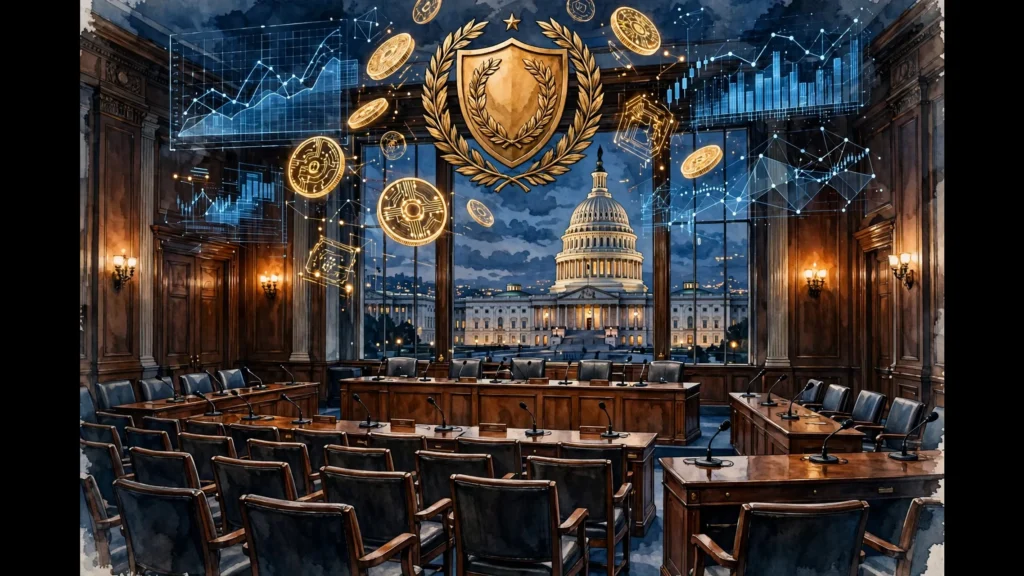
Warren Poised to Lead Senate Banking as Democrats Draft SEC-Led Crypto Bill
The politics of crypto in Washington is about to change shape. Democrats won control of both houses of Congress on November 3, and the new Congress convenes on January 3, 2027. With that switch comes a new chair of the Senate Banking Committee, the panel that writes every crypto market bill in the Senate, oversees the Securities and Exchange Commission, and screens nominees for financial regulators. Senator Elizabeth Warren of Massachusetts is the frontrunner for that chair, and her arrival would put one of the industry’s most persistent critics in charge of its legislative future. At the same time, House Democrats are quietly drafting a successor to the CLARITY Act that would hand the SEC a larger supervisory role and shrink the CFTC’s — reversing the approach the industry spent years lobbying for.
None of this is law yet — but the direction is clear enough to map.
Warren Senate Banking Crypto: What Changes in January
The Senate Banking Committee matters to crypto more than almost any other panel in Congress. It writes the market-structure bills, it oversees the SEC, and it vets the people the president nominates to run the financial regulators. Whoever chairs it sets the agenda: which bills get hearings, which get marked up, and which quietly die. If Warren takes the gavel in January, the committee’s posture toward digital assets will change sharply.
Warren has spent most of the past decade criticising digital assets, focusing on money laundering and investor losses. That record is not a secret and not a recent conversion; it is the consistent thread of her financial-policy career. Her five principles for crypto legislation, set out in July 2025, sketch the framework she would bring to the chair: leave existing securities rules for traditional assets untouched, strengthen investor protection, add safeguards against wider risks to the financial system, impose stricter anti-money-laundering and sanctions rules, and ban public officials from profiting from crypto businesses.
The change of control also resets the legislative calendar. The CLARITY Act, the market-structure bill that has dominated crypto policy for two years, is effectively dead unless it passes before January 3, 2027. Prediction market Kalshi gives it only 18% odds of becoming law before 2028. The bill passed the House in July 2025 with 216 Republicans and 78 Democrats voting in favour, but it failed a Senate procedural vote 49-50 on September 15, 2026 — eleven votes short of the 60 needed for cloture, with all 49 yes votes coming from Republicans.
Why the CLARITY Act Ran Out of Road
CLARITY’s failure was not a matter of a single bad week. The bill’s core idea was to give the CFTC the leading role in overseeing crypto spot markets, with the SEC keeping authority over assets that are clearly securities. That division was the product of years of negotiation, and it reflected the industry’s belief that the CFTC is the more natural home for digital-asset markets. But the compromise never won over enough Senate Democrats, and the September procedural vote exposed the gap: 49 votes in favour, all Republican, against a 60-vote threshold.
The politics around the bill also shifted as the year went on. The president’s own family’s crypto ventures became a flashpoint, giving Democrats a reason to demand ethics provisions that Republicans resisted. The House vote in July 2025 showed that bipartisanship was possible: 78 Democrats backed the bill. But the Senate is a different institution, and the 60-vote rule meant that a bill without broad Democratic support was always going to struggle.
Kalshi’s 18% odds of CLARITY becoming law before 2028 tell the story in a single number. The question is no longer whether CLARITY can be revived, but what replaces it — and the early answer is a bill that looks very different.
Inside the SEC-Led Crypto Bill Democrats Are Drafting
House Democrats are discussing a successor bill that would expand Representative Maxine Waters’ 2025 Crypto Investor and Consumer Bill of Rights amendment into a full market-structure framework. The reporting comes from journalist Eleanor Terrett, via CryptoPotato and Crypto In America, on November 6. Four industry sources spoke with Democratic staff on the House Financial Services Committee about the draft.
What is known is the direction. The draft would give the SEC a larger supervisory role and the CFTC a smaller one, reversing CLARITY’s CFTC-led approach. That single choice is the most consequential in the bill, because it determines which regulator sets the rules for the largest crypto markets, which agency’s enforcement culture shapes compliance, and which set of precedents governs new products.
The draft could also include monthly reserve attestations, tougher custody rules, and ethics rules on crypto activity by President Trump and other federal officials. Monthly reserve attestations would require stablecoin issuers and other firms holding customer funds to prove, every month, that the reserves backing their products actually exist. Tougher custody rules would raise the bar for how exchanges and custodians safeguard customer assets — a direct response to the collapses that wiped out retail investors in earlier cycles. The ethics provisions would address the conflict-of-interest questions raised by the president’s crypto ventures, an issue that has become a Democratic priority and a Republican objection.
Republicans have called the draft a “messaging bill” — a proposal designed to make a political point rather than to become law. That label may be fair in the short term, because the president keeps his veto, and a bill that he opposes will not become law while he is in office. The draft is a statement of intent, and the intent is an SEC-led framework with stronger consumer protections and stricter ethics rules.
What Stays the Same: Atkins, Selig, and the Regulators
For all the change coming in January, some things will not move. SEC Chairman Paul Atkins’ term runs to 2031, and the president picks agency chairs through January 2029. That means the SEC’s leadership will remain in place even as the committee overseeing it changes hands. Atkins has taken a more accommodating approach to crypto than his predecessor, and that approach will continue to shape enforcement and rulemaking in the near term — even if the new Senate Banking chair uses hearings and oversight to push back.
The CFTC is a similar story. Chairman Michael Selig said in April 2026 that he would finalise market-structure rules within his purview without Congress if needed, and that process is already underway. Agency rulemaking can move faster than legislation, and a CFTC that writes its own rules for crypto markets could create a framework that exists regardless of what Congress does.
Congress has one tool to strike down agency rules — a Congressional Review Act resolution — but the president can veto it, which limits its usefulness while he remains in office. The result is a kind of stalemate: the agencies can act within their existing authority, Congress can draft bills that cannot pass, and the real decisions get deferred. For crypto companies, that means the regulatory landscape will be shaped more by agency action than by legislation for the next two years.
There is one more piece of the picture that predates the election. Between December 2025 and April 2026, the Office of the Comptroller of the Currency conditionally approved nine crypto trust charters, including those of Ripple and Coinbase.
What the Crypto Industry Should Expect Next
The industry should expect a harder legislative environment and a busier oversight environment. Hearings will be more adversarial. Bills will be drafted with the SEC in the lead and the CFTC in a supporting role. Ethics provisions will be a recurring feature, not a one-off demand. And the path to a market-structure statute that the industry actually wants will run through a Senate Banking Committee chaired by its most prominent critic.
But the era in which the industry could expect a CFTC-led bill to glide through Congress is over, at least for now. The next two years will be defined by agency rulemaking, by oversight hearings, and by a Democratic draft bill that sets the terms of the debate even if it never becomes law. Crypto companies that plan for that world — investing in compliance, preparing for SEC-led oversight, and taking ethics rules seriously — will be better positioned than those waiting for the old bill to come back.
Frequently Asked Questions
Who is expected to chair the Senate Banking Committee?
Senator Elizabeth Warren of Massachusetts is the frontrunner to chair the committee when the new Congress convenes on January 3, 2027, after Democrats won control of both houses on November 3.
Is the CLARITY Act dead?
It is effectively dead unless passed before January 3, 2027. It passed the House in July 2025 but failed a Senate procedural vote 49-50 on September 15, 2026, and Kalshi gives it only 18% odds of becoming law before 2028.
What would the new Democratic crypto bill do?
The draft would expand Rep. Maxine Waters’ 2025 amendment into a full framework giving the SEC a larger role and the CFTC a smaller one. It is not yet introduced.
Can Congress override the SEC and CFTC chairs?
Congress can try to strike down agency rules via a Congressional Review Act resolution, but the president can veto it. SEC Chair Paul Atkins serves until 2031, and the president picks agency chairs through January 2029.
What did the OCC approve in late 2025 and early 2026?
Between December 2025 and April 2026, the OCC conditionally approved nine crypto trust charters, including those of Ripple and Coinbase.
Source: The Motley Fool/FXStreet
Related reading on MM Crypto Analysis Web
- US Treasury Cuts MEXC Off From the Financial System Over $16 Billion in Illicit Flows
- Crypto PACs Spent $170 Million in the Midterms — and the CLARITY Act May Stall for Two Years
- ICE Bets on Retail Perpetuals as Wall Street Brings Crypto Trading Onshore
More in Regulation on MM Crypto Analysis Web.
