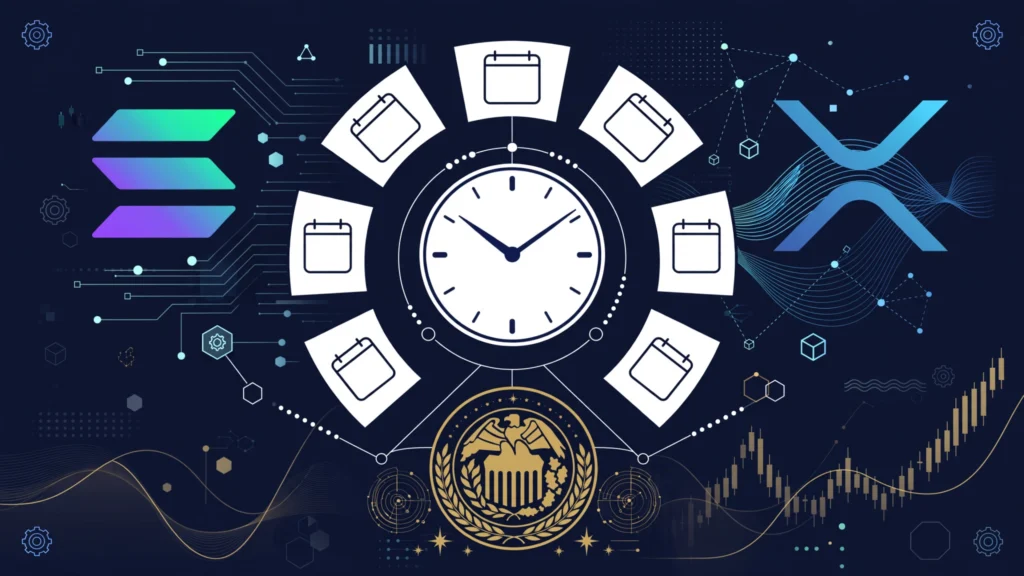
Crypto’s Packed Week: Solana’s Alpenglow Switch, XRP Amendment, Fed Call
Crypto markets have a stacked calendar this week, with protocol upgrades, a landmark Federal Reserve decision, and major exchange earnings all landing within days of each other. Here is what traders are watching.
A week like this matters because it brings together several different kinds of news at once. Protocol upgrades speak to how individual networks function and evolve. A central bank decision speaks to the wider economic backdrop in which all risk assets are traded. Company results speak to how businesses that serve crypto users are performing. Regulatory developments speak to the rules under which those businesses and networks may operate in future. When those strands arrive within a few days, it can be harder to separate one influence from another, and a move in one market can be read, rightly or wrongly, as a reaction to a different event entirely.
The week described here contains all four kinds of event. The sections below take each one in turn, explain in general terms why it is being watched, and consider what could make its interpretation more complicated. Nothing in this article is a prediction about how prices will move, and none of it is a recommendation about any asset.
Solana’s Alpenglow Consensus
Solana switches to its Alpenglow consensus mechanism today, on October 21. The upgrade is the network’s most significant consensus overhaul to date and is designed to speed up finality and strengthen the chain’s resilience. Validator coordination in the days around the switch will be closely watched.
In general terms, a consensus mechanism is the set of rules by which the computers that run a network agree on the order and validity of transactions. It is one of the most fundamental parts of a blockchain, because without agreement there is no shared record that everyone can trust. Changing that mechanism is therefore a more consequential step than an ordinary software update. It touches how the network reaches agreement, how quickly that agreement becomes settled, and how the network behaves if some participants are slow, offline, or disagree.
Finality, in this general sense, is the point at which a transaction can be treated as settled and unlikely to be reversed. Faster finality can matter for applications that need to know quickly whether a payment or trade has gone through. Resilience, in this general sense, is about how well a network keeps working under stress, including when parts of it fail or when conditions are difficult. An upgrade described as strengthening resilience is therefore being judged not only on speed in normal conditions, but on steadiness in unusual ones.
XRP Ledger Amendment
The XRP Ledger activates a bug-fix amendment on October 23. Amendments on the XRP Ledger require supermajority validator support, and successful activation keeps the network’s upgrade cadence on track.
An amendment, in general terms, is a proposed change to the rules of a network. On the XRP Ledger, the fact that amendments require supermajority validator support means that a change cannot take effect on the say-so of a small group. A supermajority threshold is a deliberately high bar: it is designed to ensure that a change has broad backing before it becomes part of the shared rules. That structure gives amendments a particular character. They are not imposed overnight, and they are not adopted casually. They move forward only when a large share of those who run the network have signalled support.
Ethereum’s Glamsterdam Hits Hoodi
Ethereum’s Glamsterdam upgrade reaches the Hoodi testnet on October 26, following its successful Sepolia activation. The upgrade introduces parallel transaction processing and block construction improvements. Mainnet timing is not yet confirmed.
A testnet, in general terms, is a version of a network used for testing, separate from the main network where real value moves. Upgrades are often tried on testnets first so that problems can be found and fixed before they affect the main network. The sequence described here, with Sepolia activation followed by Hoodi, is an example of that staged approach. Each testnet stage gives developers and network participants a chance to observe how the upgrade behaves in a live-like setting, without the consequences that would follow from a problem on the main network.
Parallel transaction processing, in general terms, means handling more than one transaction at the same time rather than strictly one after another, where that is safe to do. The appeal of such an approach is straightforward to describe in principle: if independent transactions do not interfere with each other, processing them in parallel can make better use of available capacity. The challenge is equally straightforward in principle: the network must still be sure that the final result is correct and consistent, even when work is done at the same time.
The Fed’s October Decision
The Federal Reserve decides on interest rates on October 28. Bitcoin and crypto have been trading with unusual sensitivity to macro data: hot September CPI and PPI prints revived talk of rate moves, and traders are watching whether the central bank holds or shifts. FedWatch pricing has shown roughly 85% odds of rates holding in the 3.75–4.00% range.
In general terms, a central bank interest rate decision matters far beyond the banking system because interest rates influence borrowing costs, saving returns, and the relative appeal of different kinds of assets. When rates are higher, holding cash or low-risk assets can look relatively more attractive. When rates are lower, or expected to fall, riskier assets can look relatively more attractive by comparison. That is a very general relationship, not a rule that holds in every circumstance, but it helps explain why crypto markets, like other markets, pay close attention to central bank decisions.
Inflation data is central to that attention. The CPI and PPI are widely watched measures of price pressures in the economy. In general terms, the CPI tracks prices paid by consumers, while the PPI tracks prices received by producers. When such measures come in hotter than expected, meaning price pressures look stronger, it can revive discussion about whether a central bank will keep rates higher for longer, or move them in a different direction. When they come in cooler, discussion can move the other way. The original report describes hot September prints reviving talk of rate moves, which fits that general pattern of inflation data shaping expectations.
Earnings Season
Coinbase and Strategy report quarterly results on October 29. Coinbase’s numbers will offer a read on retail and institutional trading activity, while Strategy’s disclosure will update its Bitcoin accumulation pace.
Company results matter for crypto markets in a different way from protocol upgrades or central bank decisions. They provide information about the businesses that sit between users and the crypto economy. An exchange, in general terms, earns much of its activity from people trading, and its results can therefore be read as an indicator of how active those traders have been. If trading activity is strong, it may reflect broad engagement. If it is weak, it may reflect caution or quieter conditions. The distinction between retail and institutional activity adds another layer: retail activity reflects individual users, while institutional activity reflects larger organisations, and the two do not always move together.
Regulatory Watch
The SEC’s public comment period for “Regulation Crypto Assets,” its proposed safe harbor for token offerings, closed on October 20 after drawing about 140 submissions. Follow-up from the SEC and Treasury on stablecoin and market-structure rules could also move markets this week.
A public comment period, in general terms, is a stage in which a regulator invites views from the public, from industry, and from other interested parties before finalising a proposal. The number of submissions, about 140 in this case, gives a rough sense of how much engagement a proposal attracted, though it does not by itself reveal what those submissions said or whether they agreed with the proposal. Some submissions may support it, some may criticise it, and some may suggest changes.
A safe harbor, in general terms, is a provision that offers clearer conditions under which certain activity is treated as compliant, provided specified requirements are met. For token offerings, the idea of a safe harbor is therefore about clarity: giving those who issue tokens a clearer sense of what is expected of them, rather than leaving them to guess how existing rules apply. Whether a particular safe harbor proposal achieves that clarity, and for whom, is a question that commenters will often debate in detail.
Why This Combination Matters
Taken together, the week brings a test of execution, a test of governance, a test of economic expectations, and a test of business performance. The protocol events test whether networks can change themselves smoothly. The Federal Reserve decision tests whether macroeconomic expectations match the central bank’s actual choice. The earnings reports test whether crypto-facing businesses are seeing the activity that broader market conditions might suggest. The regulatory developments test whether the rule-making process is moving toward greater clarity.
Frequently Asked Questions
What is happening on October 21?
Solana switches to its Alpenglow consensus mechanism on October 21, in what is described as the network’s most significant consensus overhaul to date.
What is the XRP Ledger event on October 23?
The XRP Ledger activates a bug-fix amendment on October 23, and amendments on the network require supermajority validator support.
What is the Ethereum event on October 26?
Ethereum’s Glamsterdam upgrade reaches the Hoodi testnet on October 26, following its successful Sepolia activation, and mainnet timing is not yet confirmed.
What is expected from the Federal Reserve on October 28?
The Federal Reserve decides on interest rates on October 28, and FedWatch pricing has shown roughly 85% odds of rates holding in the 3.75–4.00% range.
Which companies report on October 29, and what will their results show?
Coinbase and Strategy report quarterly results on October 29, with Coinbase’s numbers offering a read on retail and institutional trading activity and Strategy’s disclosure updating its Bitcoin accumulation pace.
Source: Blockchain Reporter
Related reading on MM Crypto Analysis Web
- Crypto Market Close October 28: Breadth Turns Positive as Bitcoin Holds $81,254
- Crypto Market Wrap October 29: Bitcoin Holds Above $81,000 After Fed Hold
- Whales Turn Bearish on Bitcoin for First Time Since June as ETF Flows Stabilize
More in Markets on MM Crypto Analysis Web.
